


Published on: 06/26/2026


Description
ALBANY, Ga. (WALB) — It takes seconds. A few taps on a phone, laptop, or tablet, and vape products are available for purchase online. But for parents in Albany and across Georgia, the concern goes far beyond what teens can find on the internet.
Law enforcement and health professionals say the real issue is how easily young people are accessing vapes and the serious health consequences that come with it.
Since January 2026, Albany police have documented at least 50 cases involving children and vapes, including overdoses. It’s a problem that extends beyond school hallways and into homes, storefronts, and peer groups.
“You think it’s cool but this has real consequences,” one parent told us during a recent community forum on youth vaping.
THE ACCESS PROBLEM: EASIER THAN YOU THINK
Vape products are widely available online. A simple search reveals pages of results — flavored nicotine products, sleek devices, and marketing that often downplays the risks. While some websites advertise age verification checks, law enforcement says the safeguards may not be strong enough to keep products out of teens’ hands.
But online access is only part of the problem.
Deputy Chief Wendy Luster with the Albany Police Department says the most common way teens are getting vapes is through their peers.
“A lot of the youth are taking these vapes to school and passing them on to their friends,” Luster said. “Sometimes they’re just pressured to use them because they think it’s a cool thing to do.”
The peer-to-peer passing creates a domino effect. One teen buys a vape — either online or in a store — and suddenly it’s circulating among dozens of classmates. Parents may not even know their child has access to one.
Where are teens getting vapes?
- Online retailers
- Older friends or family members
- Other students at school
- Convenience stores and vape shops that may not be checking IDs closely enough
THE ADDICTION TRAP: NICOTINE’S GRIP ON DEVELOPING BRAINS
One of the most dangerous aspects of vaping is how addictive it is — especially for young people whose brains are still developing.
Dr. Derek Heard, Medical Director for Primary Care at Phoebe Physicians Group, explains that nicotine in vape products is one of the most addictive substances available.
“Even though some industries have told kids that vaping is not as harmful as cigarettes, the issue is that they can be just as addictive,” Dr. Heard said. “And any time you’re ingesting unnatural chemicals into your body, there’s going to be some harmful effect from that.”
The addiction manifests quickly. Teens who vape regularly report cravings, irritability when they haven’t used the product, and difficulty quitting — the same patterns seen with traditional cigarette smokers.
“The nicotine really is not any different,” Dr. Heard said. “It’s affecting those same centers in the brain that cause that addictive desire.”
Here’s what many teens don’t realize: vape products contain hundreds of chemicals, many of which are found in pesticides.
“We know that over time, it’s going to have an effect on the lungs,” Dr. Heard said. “The jury’s still out about exactly what’s going to happen because it takes time. It took over 50 years for us to learn all the different harmful effects of smoking cigarettes. So we’re still in this first generation of vaping. We don’t know all the long-term effects.”
But doctors aren’t waiting for decades of data to warn young people. The chemicals in vapes are known to be harmful, and the long-term consequences are likely to mirror what we’ve seen with traditional smoking.
THE HEALTH RISK
One of the most serious potential consequences is cancer.
Dr. Heard warns that vaping could lead to multiple types of cancer, including:
Lung Cancer — The most common cancer associated with smoking and vaping. Lung cancer can be deadly, particularly if not found at an early stage and it spreads throughout the body.
Heart Disease & Coronary Heart Disease — Smoking and vaping have been linked to heart disease, which can be a lifelong problem requiring ongoing treatment and medication.
Congestive Heart Failure — A condition where the heart can’t pump blood effectively, leading to fluid buildup in the lungs and body. This is a serious, chronic condition that significantly impacts quality of life.
Bladder Cancer — A less commonly discussed but very real risk associated with smoking and nicotine use.
“Those are problems that you don’t want if you’re a kid,” Dr. Heard said. “Cancer is terrible. It’s one of those things that it can be deadly, particularly if it’s not found at an early enough stage and it spreads throughout the body.”
Beyond cancer, vaping poses risks to lung development, cardiovascular health, and brain function during critical developmental years.
Teens who vape may experience:
- Reduced lung capacity and respiratory issues
- Increased heart rate and blood pressure
- Impaired memory and concentration
- Weakened immune system
- Potential gateway to other substances
WHY TEENS THINK IT’S SAFE
Many teens believe vaping is a safer alternative to smoking cigarettes. The marketing often reinforces this idea — “no smoke,” “just vapor,” “cleaner than cigarettes.”
But Dr. Heard compares this flawed logic to driving: “Going 200 miles an hour in a car is not as bad as going 1,000 miles an hour in a car. But it’s still harmful because you’re still going much faster than a person should be going.”
The same applies to vaping. Just because it may be less harmful than cigarettes doesn’t mean it’s safe. And the cost is real — both financially and health-wise.
“You’re spending thousands of dollars a year on a product that’s actively trying to harm you and kill you,” Dr. Heard said. “That honestly does not make sense. Why would you pay for something to harm you?”
WHAT PARENTS CAN DO
Law enforcement emphasize that this is not just a police problem or a school problem — it’s a community problem that requires parents to be actively involved.
Know what’s in your child’s backpack. Monitor what they bring home from school. Don’t take anything for granted.
Have the conversation. Talk to your teen about vaping. Explain the health risks, the addiction potential, and why peer pressure isn’t a good reason to try it.
Get educated. Visit your local health department or the Georgia Department of Public Health website to learn more about vaping and its effects.
Watch for warning signs. If your teen is irritable, has trouble concentrating, or seems secretive about their activities, vaping could be a factor.
Get involved. Know your teen’s friends, their activities, and where they spend their time. Build a relationship where they feel comfortable talking to you about peer pressure.
Seek help if needed. If your teen is already vaping, talk to a healthcare provider about cessation resources and support.
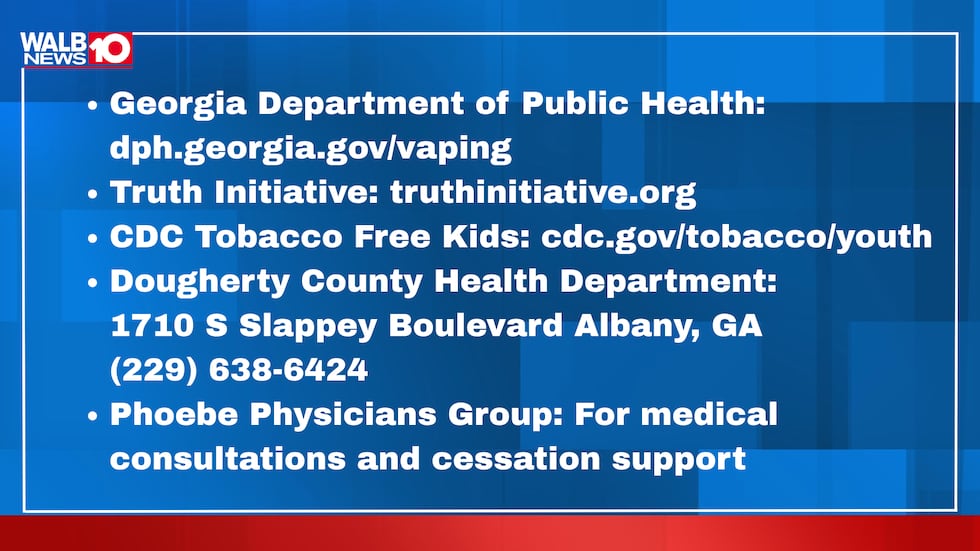
Need help or information? Here’s where to start:
Have a news tip or see an error that needs correction? Let us know. Please include the article’s headline in your message.
To stay up to date on all the latest news as it develops, follow WALB on Facebook, Instagram and X. For more South Georgia news, download the WALB News app and add WALB as a preferred source on Google.
Copyright 2026 WALB. All rights reserved.
News Source : https://www.walb.com/2026/06/26/vaping-there-have-been-50-cases-2026-involving-children-albany/
Other Related News
06/26/2026
ALBANY Ga WALB The United States advanced to the knockout stage of the 2026 FIFA World Cu...
06/26/2026
ALBANY Ga WALB Chasity James said she wants to know what really happened to her nephew Ju...
06/26/2026
ALBANY Ga WALB - The US Department of Labor says it is reviewing safety security and stude...
06/26/2026
FRIDAY PM Showers and storms will arrive in the early afternoon and begin to taper off int...
06/26/2026
CAIRO Ga WCTV - Despite the increase in daily showers after South Georgia experienced extr...

Follow

Download Our App


Copyright 2022 © Albany Metro Community. All Rights Reserved