


Published on: 04/02/2026


Description
ALBANY, Ga. (WALB) - Artificial sweeteners show up everywhere—from coffee packets like Sweet’N Low and Splenda to “zero sugar” sodas and sugar-free snacks. Many people want to know how they work in the body and whether there are any long-term concerns.
Dr. Tracy Brigman, a clinical associate professor and extension nutrition specialist at the University of Georgia, discussed what the science says—and what to keep in mind if you’re trying to reduce added sugar.
What are artificial sweeteners?
Artificial sweeteners—often called sugar substitutes—are intensely sweet compounds used to provide sweetness without the calories of sugar.
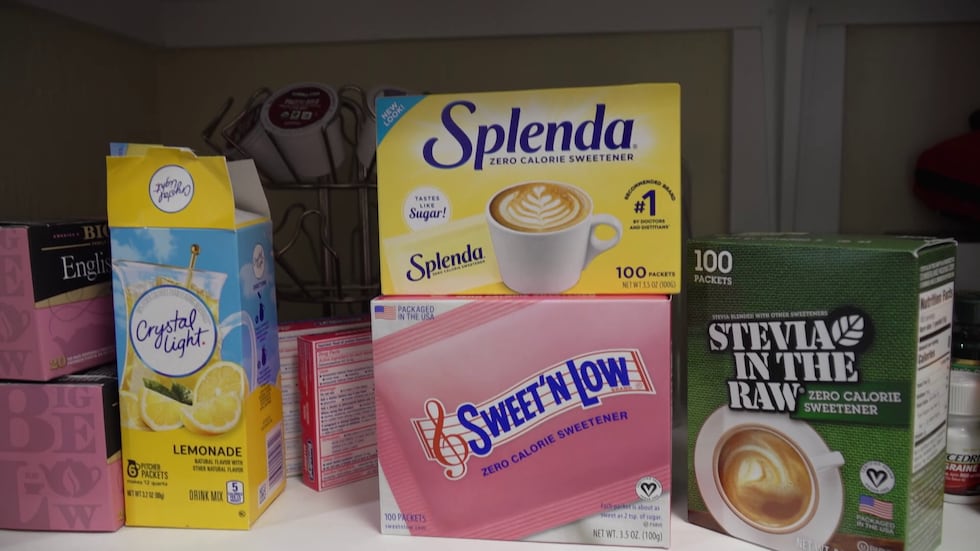
As Dr. Brigman put it, they’re “intensely sweet sugar substitutes that are used to provide taste without calories.”
Some are “derived synthetically,” meaning they’re made from molecules, while others are “modified from a sugar molecule or a protein molecule.”
What makes them different from regular sugar is potency: They can be “intensely sweet, sometimes 100 times as sweet as sugar,” which is why you need such a small amount.
Because the body often doesn’t treat them like sugar, Dr. Brigman said, “Many of them are not digested or recognized by the body.”
In many cases, that means “it’s going to go through your system without affecting your blood sugar or increasing any calories.”
Where do Sweet’N Low and Splenda come from?
Two of the most common examples are:
- Sweet’N Low: made from saccharin, which Dr. Brigman described as “a synthetic derivative… a purely made product.”
- Splenda: made from sucralose, which she explained is “sugar that was modified… that it’s not digested by the body.” She added that it can provide sweetness “without giving calories, but without being metabolized or digested or incorporated into our system.”
Do artificial sweeteners affect blood sugar or insulin?
Dr. Brigman said most research shows artificial sweeteners don’t directly raise blood sugar: “Not directly. So most of the science says it doesn’t directly affect blood sugars.”
But she stressed that the food around the sweetener still matters.
Her example: “If I have a sugar-free cookie, well, there’s still flour, which is a carbohydrate. That’s going to affect my blood sugar.”
Dr. Brigman also pointed to early research on gut health.
“There have been some preliminary studies where artificial sweeteners may affect the gut microbiome, leading to reduced insulin sensitivity. But again, there’s not anything definitive yet,” she said.
‘Sugar-free’ doesn’t mean ‘eat unlimited amounts’
Another issue isn’t the sweetener itself—it’s how we respond to the label.
Dr. Brigman said some people see sugar-free and assume unlimited portions: “Oh, sugar-free, I can have the whole package.” But she emphasized it’s meant “to replace the same portion size that you were going to have in the first place.”
Do artificial sweeteners cause cancer?
“Right now, there is no evidence that it’s linked to a higher risk of cancer in people.”
She noted some studies suggest other risks, but teasing out cause and effect is complicated: “Some studies suggest that long-term use can lead to an increased risk in stroke and heart disease.”
At the same time, “there’s other factors that affect our increased risk for stroke, heart disease and cancer… so it’s hard to split the two.”
Can artificial sweeteners cause bloating or digestive issues?
If you’ve ever felt bloated after a “zero sugar” drink, it can be hard to know what caused it.
Dr. Brigman said it could be “a combination of both” carbonation and sweeteners—and that digestion is “very individualized.”
Her recommendation is practical: “The only way to determine if it’s the sweetener or the carbonation is to separate the two.”
- Try something with carbonation but no sweetener.
- Try something with the sweetener but no carbonation.
Are artificial sweeteners safe for kids and pregnancy?
Dr. Brigman said, “most artificial sweeteners are acceptable in small amounts” during pregnancy, “with the exception of saccharin.”
“They have shown that saccharin can cross the placenta.”
Artificial sweeteners are generally recognized as safe, but Dr. Brigman said “more research is needed in that young population.”
She also offered clear guardrails:
- “It is definitely not for kids under the age of two.”
- For kids over 2, experts typically recommend “no more than six to eight ounces of food or beverage with that artificial sweetener in it per day.”
How much is ‘too much’ for adults?
Dr. Brighman referenced the Acceptable Daily Intake (ADI), which is based on body weight.
She said the calculated safe range for many adults can be high.
“The average amount that an adult can safely take in is between 20 and 75 packets of sweetener a day.”
But she immediately added, “I definitely don’t recommend that. Like, I don’t want to hit that goal.”
For most people, she said, they’re best used “in small, very small amounts for a short period of time or just every once in a while.”
Better alternatives: retrain your taste buds
Many people swap sugar for honey, agave or brown sugar—but Dr. Brigman said those options still behave like sugar in the body.
“They’re all going to affect your blood sugar the same way that regular table sugar does… It’s going to be a fast spike.”
She recommends retraining your palate by slowly cutting back: “If we’re used to a really sweet tea… cut back a little bit each time and retrain your palate.”
Other practical swaps she suggested:
- Use “something natural like fruits” when it makes sense—because even though fruit contains natural sugar, “it gives us other nutrients than table sugar… would give.”
- In baking, “I can use half the amount and still have an acceptable product.”
- Add spices like cinnamon and nutmeg: “We associate that with sweet treats,” she said, and it can help you cut sugar while keeping that sweet feeling.
She also emphasized avoiding drastic changes: “We don’t want to go for… absolutely none and then us being miserable with the foods that we eat.” Instead, use substitutes “short term, small amounts, very infrequently till we can get to the point where we don’t need to taste that high sugar content.”
Have a news tip or see an error that needs correction? Let us know. Please include the article’s headline in your message.
To stay up to date on all the latest news as it develops, follow WALB on Facebook and X (Twitter). For more South Georgia news, download the WALB News app from the Apple Store or Google Play.
Copyright 2026 WALB. All rights reserved.
News Source : https://www.walb.com/2026/04/01/defining-artificial-sweeteners-do-they-do-more-harm-than-good/
Other Related News
04/02/2026
ALBANY Ga WALB - As most of South Georgia remains under severe drought conditions the Geor...
04/02/2026
ALBANY Ga WALB A cancer diagnosis can change more than a persons health it can reshape ho...
04/01/2026
LEE COUNTY Ga WALB A traffic accident involving a train and a vehicle occurred on US-19 T...
04/01/2026
DAWSON Ga WALB A kindergarten student from Terrell County was found walking along a major...
04/01/2026
TODAY Warming up into the mid 80s this afternoon Scattered afternoon showers and thunderst...

Follow

Download Our App


Copyright 2022 © Albany Metro Community. All Rights Reserved