


Published on: 10/13/2026


Description
Maryville, Tennessee (Atlanta News First) - When Kyle Skeen moved back to the U.S. after working in London, he said he quickly noticed an abundance of something he hadn’t expected — cameras.
“I was quite surprised when I came back and just saw the scale of what was going on,” he said.
Located just south of Knoxville, the small city of Maryville, Tennessee where Skeen moved in 2024 has 16 Flock Safety automatic license plate readers.
“I cannot leave my neighborhood without passing a Flock camera,” he said. “No matter which way I go, every time I leave my house, it’s put into the database.”
Skeen is more than familiar with the concept of surveillance: his more than 20-year career with the United States Navy culminated in his role as a senior intelligence analyst, and that stint in London was working in intelligence for NATO Maritime Command.
But Skeen said what he found when he started digging into the details — from the nationwide scope of the searching by law enforcement to how his community came to be in business with Flock — still left him shocked.
“The power should lie with the people, and these kind of systems, it tilts the balance,” he said.
Flock’s national network of more than 120,000 cameras is knit together through thousands of contracts the company has signed with communities large and small, with Flock executives touting this as local control.
But as a growing number of communities have reconsidered their relationships with Flock in light of sustained public criticism, the genesis and content of those contracts have drawn scrutiny as well.
“It seems like people are realizing that they’re starting to pop up just everywhere, the sheer volume of them, and they’ve been starting to ask questions,” Skeen said, “and usually when people find the answers to the questions, they get even more concerned.”
Cameras and contracts without a vote
In an April interview with InvestigateTV and in multiple company publications since, Flock has argued that local communities have complete control over their implementation of the technology.
“I think the city council has been democratically elected by the community to go make these sort of decisions,” Flock Chief Communications Officer Josh Thomas said in that April interview. “And if the community doesn’t like the city council’s decision, they should go vote differently. But it is the city council’s job, as a duly elected representative, to go decide how the budget should be spent.”
However, InvestigateTV found numerous instances in communities across the country where cameras were installed and paid for first, with approval from local elected officials sometimes coming later — if at all.
In Maryville, the police chief recently explained during a city council work session that the department began using Flock technology in 2020, but records show the council didn’t vote on the issue until July 2024 when the city needed a right-of-way permit from the state.
“I did not vote for this, and to my knowledge, not a single American voted for this,” Skeen said.
He and others have expressed their concerns about privacy and transparency to local elected officials, including at the public work session, and the city has said it is gathering information.
“We just wanted to hear from everybody and kind of gather information. And to be honest with you, learn more as a council because there’s a lot of things that we learned today from you guys and from the Chief as well,” Maryville Mayor Andy White said at the meeting.
Over the last few months, similar meetings have taken place in hundreds of communities across the country where citizens or elected leaders have questioned the procurement of Flock technology without explicit council or commission approval.
Law enforcement officials have largely defended these actions — with emotions sometimes running high.
“It’s my equipment. I don’t tell you guys when I buy a new gun,” Ron Ambrozaitis, then police chief, said to city leaders during a July public meeting in Chetek, Wisconsin. “You guys want to call and cancel it, go right ahead. I have no problem. But the next time grandma’s missing, or your car got stolen, or you’re missing money, and I can’t ... I can’t help you.”
At the end of August, Ambrozaitis announced his retirement and stepped down from active duty.
Buying under the limit
In Knox County, Tennessee, as local law enforcement looked to expand its Flock portfolio to more than 400 cameras in mid-August, then County Mayor Glenn Jacobs sent a letter to Flock questioning the validity of the county’s contract with the company.
He alleged the payments the Knox County Sheriff’s Office had been making since 2020 appeared to have been outlined to strategically “escape” the county’s contract oversight procedures.
Records show the sheriff’s office purchased Flock cameras in batches of $24,990 — exactly $10 under the $25,000 threshold that would have required a review by the county mayor’s office — as well as in split invoices of $12,500 that combined would have triggered a review.
“If you hit the exact price, minus ten bucks, it’s a red flag to me,” Knox County Commissioner Larsen Jay said during a public meeting the body held after becoming aware of the payments. “[The payment record] to me shows a pattern of buying things right under the threshold again and again and again. That concerns me.”
County Law Director David Buuck, who reviewed the paperwork with the mayor, also didn’t mince words.
“It’s one of the screwiest contracts I ever read because it basically says every time you do another one of these $12,000, $13,000 under-the-limit orders, it automatically renews the contract,” the Buuck said during the meeting.
Now former mayor Jacobs said the deal should never have skipped his desk.
“If it’s a contract: that has to come to commission, that has to come to me,” he said. “That didn’t happen.”
By the time commissioners took up the matter, Knox County’s sheriff’s office had 143 Flock license plate readers active — and according to Jacobs’ letter, more than a quarter of a million taxpayer dollars had been spent.
In light of allegations such as those levied by Knox County leaders, InvestigateTV asked Flock directly if the company works with agencies to avoid budgetary reviews.
“Flock provides public agencies with product information, pricing, and procurement documentation,” a spokesperson said in an emailed response. “Purchasing thresholds, sole-source requirements, and whether council or commission approval is required are governed by each agency’s applicable laws, policies, and procurement procedures.”
Contract questions lead to communities pulling the plug
Knox County ultimately pulled the plug, declaring its own Flock contract invalid and calling for the removal of the cameras. When the company missed a county-imposed deadline to do so, the newly-elected mayor had public works crews cover them. The sheriff’s office has since declared it is no longer using any fixed ALPR systems.
Knox County isn’t the only place that has turned off its cameras — the Institute for Justice has catalogued more than 250 communities that have canceled or will not renew their contract with Flock Safety.
The mayor of Neenah, Wisconsin, posted a video to Facebook about how the city terminated its relationship with Flock over security concerns and “mounting evidence” that the company “wasn’t doing what it was supposed to in the contract.”
Ledyard, Connecticut, police got a notification in September from Flock about a security breach involving the system.
The notification appears to have been the final straw for Ledyard Police Chief Ken Creutz, who said he had already had growing concerns about the technology after watching recent congressional hearings.
“The technology may do some things that we were told that it can’t do,” he said in a letter to local elected officials. “The only prudent decision was to take a timeout from the whole Flock situation.”
The department severed its contract with Flock altogether, and the town’s public works department covered all four of the town’s cameras.
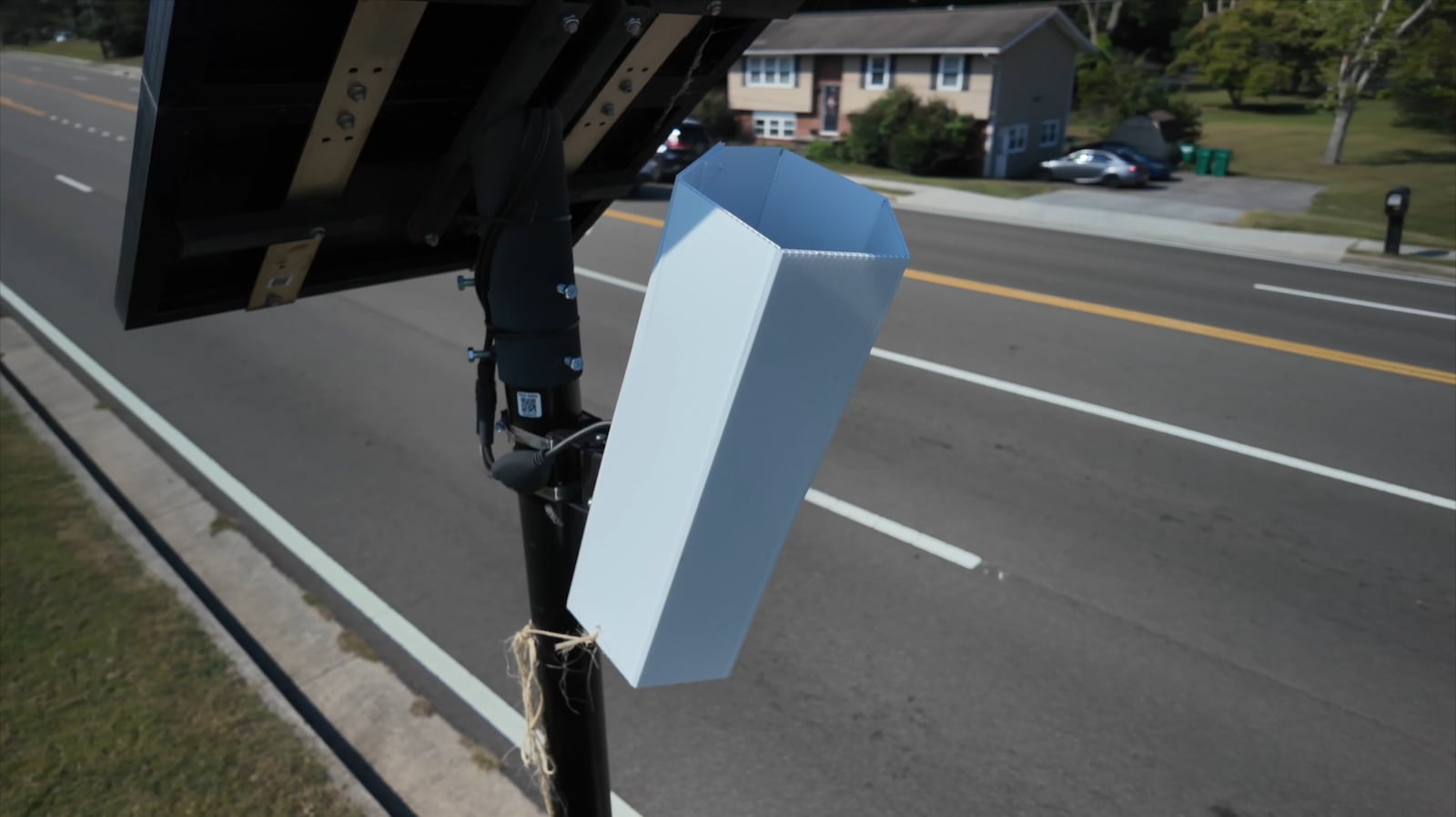
Ledyard signed a two-year contract and still owes the company around $12,000. Town leaders have said they are willing to pay the price to get out of the contract, but given the circumstances, some said they want to look into legal recourse because they feel they could have been sold the system on false pretenses.
“If we can display legally that we’ve been misled in this contract, in what we signed up to in terms of the conditions. To me, that’s grounds at least for something,” said Ledyard Town Councilor Tim Ryan. “It makes a statement, right? I don’t want to spend more than we’re already losing.”
The ‘Sole Source’
There are plenty of jurisdictions that are not pulling back.
For example, Dallas is keeping its more than 600 Flock cameras for now, even after Texas Governor Greg Abbott revoked state funding and residents have pressed city leaders on how the system got there in the first place.
City council member Gay Donnell Willis defended the technology’s track record in the city at a public forum hosted by community advocacy groups in mid September.
“Dallas has had 50 homicides solved, where a suspect was identified and arrested since 2023. It’s incredible,” she said in an interview with InvestigateTV. She also said homicide investigations justify the city’s ALPR data retention period of 365 days.
“It’s important to be able to have that information to pinpoint where a suspect might have been to help catch them and arrest them.”
Stephanie Drenka with the Texas Civil Rights Project, one of the forum host organizations, questioned why Dallas has embraced the technology so fully while nearby cities move the opposite direction.
“Dallas, uniquely, has embraced Flock technology in a way that other cities in Texas are [not],” Drenka said. “They’re rejecting it, and they’re canceling contracts. It’s very puzzling to me why our city, with the views that citizens and residents have been expressing, our leadership does not seem to be listening to that.”
Dallas’ most recent Flock contract, worth $5.7 million, was approved by city council — but exempted from competitive bidding because Flock was listed as the “sole source” for the automated license plate reader technology sought by the city.
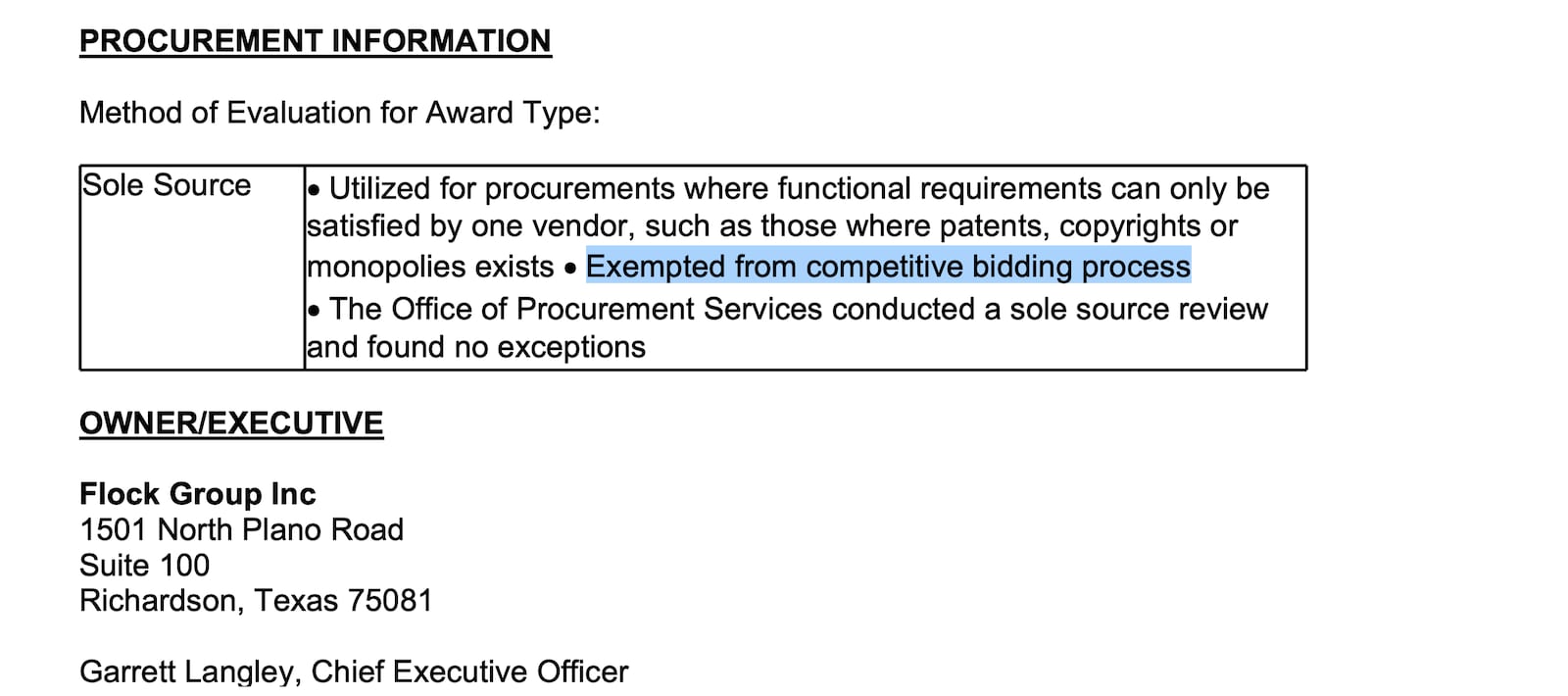
Councilmember Willis defended that arrangement, too.
“I think anyone can bid, but there are technologies and proprietary tools that maybe one technology has over another,” she said. “My understanding is that right now, they’ve got the most advanced technology, and until a competitor is able to match that, they’re the only one in the market and they meet the needs that Dallas has for solving crimes, then that might be the reason for a sole source.”
InvestigateTV found dozens of examples of similar sole-source paperwork in other cities and counties across the country — which municipalities used to competitive bidding in an industry that has several competing license plate reader companies.
With examples dating from 2020 to 2026, letters InvestigateTV reviewed were presented to jurisdictions of all sizes, all with nearly identical language.
In response to InvestigateTV’s questions about these “Sole Source Letters” a spokesperson said in a statement:
“Flock provides sole-source letters when public agencies request documentation for their procurement files, purchase orders, invoice processing, renewals, or sole-source justifications. The letters describe Flock’s integrated hardware, software, managed services, and system compatibility so an agency can evaluate whether the solution meets its applicable sole-source criteria. Each public agency is responsible for navigating its own procurement process and complying with the laws, policies, and approval requirements that apply in its jurisdiction.”
Dallas leaders authorized the city’s contracts with Flock, sole-source justification included, through consent agenda votes in 2022 and 2025 with minimal public council discussion, and critics argue the arrangement has left residents with no real say.
“If the grand majority of Dallas was in favor for Flock, then I can respect that. But we never had a vote on this either,” Santiago Diza of the Latino Leaders Coalition, another of the forum host organizations, said. “A product that was sold to the police department and we had no say in it.”
A database, not just a photo
Flock has frequently noted that sharing access to license plate reader data is “optional” for agencies, but in its sole-source letters the company highlights its integrated data network as its premier proprietary offering, calling it “a centralized system that facilitates collaboration across multiple jurisdictions, supporting a more robust and efficient public safety network.”
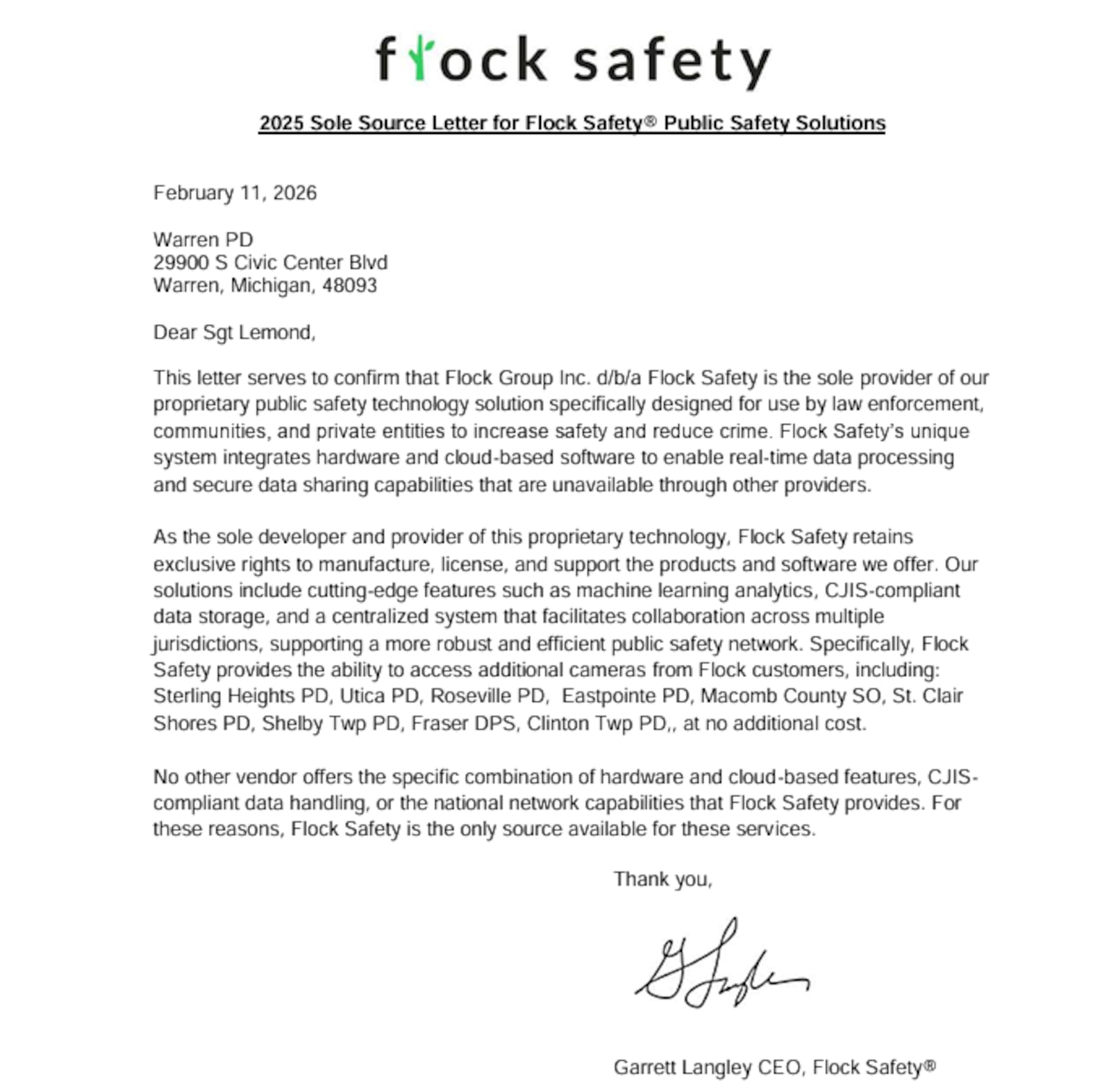
More than 6,000 jurisdictions are connected to the Flock system, and what the company considers a selling point, Drenka argues is precisely what makes it problematic.
“I think that is why Flock in particular has become such a dangerous entity, almost this monopoly, because of the data sharing and the network that they’re able to build when they have the exclusivity with these agencies,” Drenka said. “Flock has infiltrated communities across the country and we have very limited knowledge about how our data is being accessed and used by those other entities.”
Skeen, the Navy veteran now living in East Tennessee, agrees, and said he thinks the public largely misunderstands what the system actually does.
“This isn’t just one camera on a post on the side of the road. This is a national network,” Skeen said.
He said he’s found the volume of searches against his local cameras to be “staggering” — especially because they’re not all coming from nearby.
“They average about 63,000 searches a day,” Skeen said of cameras in his area. “All the way as far out as California, we’re seeing a massive amount of searches on the cameras here — in Tennessee.”
Jennifer Sanchez of the Texas Civil Rights Project said this functionality has led to distrust.
“Who is accessing this data? Who knows everything about us? Who is watching us? Who is collecting our every move? People have no trust in these cameras. People are scared of these cameras,” Sanchez said.
“If our every move is being recorded and stored in a database for 365 days, that’s scary.”
Flock has refuted that it “tracks” individuals, asserting that its ALPR snapshots are simply point-in-time indications of a vehicle’s location, but Skeen argues that what looks like scattered snapshots ultimately becomes something else entirely once it’s compiled.
“I worked in military intelligence, so I understand the value of information. And once that information by itself is put together, it becomes intelligence,” he said. “I understand when the system like this takes bits of information, like a photo on one street and a photo on another, and then puts that into a database and correlates that, that becomes intelligence.”
Skeen also pushed back on the notion that because the cameras capture license plates that are in public view, there is no invasion of privacy or Fourth Amendment concern.
“Tracking every citizen going around, whether they’re going to the store, to church, to the gun range, or wherever, it’s a lot different than just being seen in public. Being followed in public is a different thing,” he said.
Some vehicles able to ‘opt-out’
But is “every citizen” actually subject to the watchful lenses of Flock’s 120,000-plus cameras?
While digging into the system and how his community utilizes it, Skeen said he discovered the existence of something that further staggered him: a list of vehicles the cameras are built to ignore.
In the same way someone can “whitelist” an e-mail address they trust to allow it to pass through a spam filter, Skeen said he learned that agencies using Flock can designate license plates that effectively pass by the cameras without being flagged.
“It is a list of special plates, or assigned category, which people are suppressed from the system. It means, basically, when you drive around, the camera ignores your car,” Skeen said.
Skeen filed public records requests with agencies in his community, including with Maryville, and the city turned over three license plates on its “whitelist,” set to never expire, but no names attached.
When he asked who decides which vehicles get that kind of permanent exemption, he said the city told him there was no formal process at all.
“They told me there’s no policy and no instruction, and it’s up to a single person there. And they get to decide who goes on the list,” Skeen said.
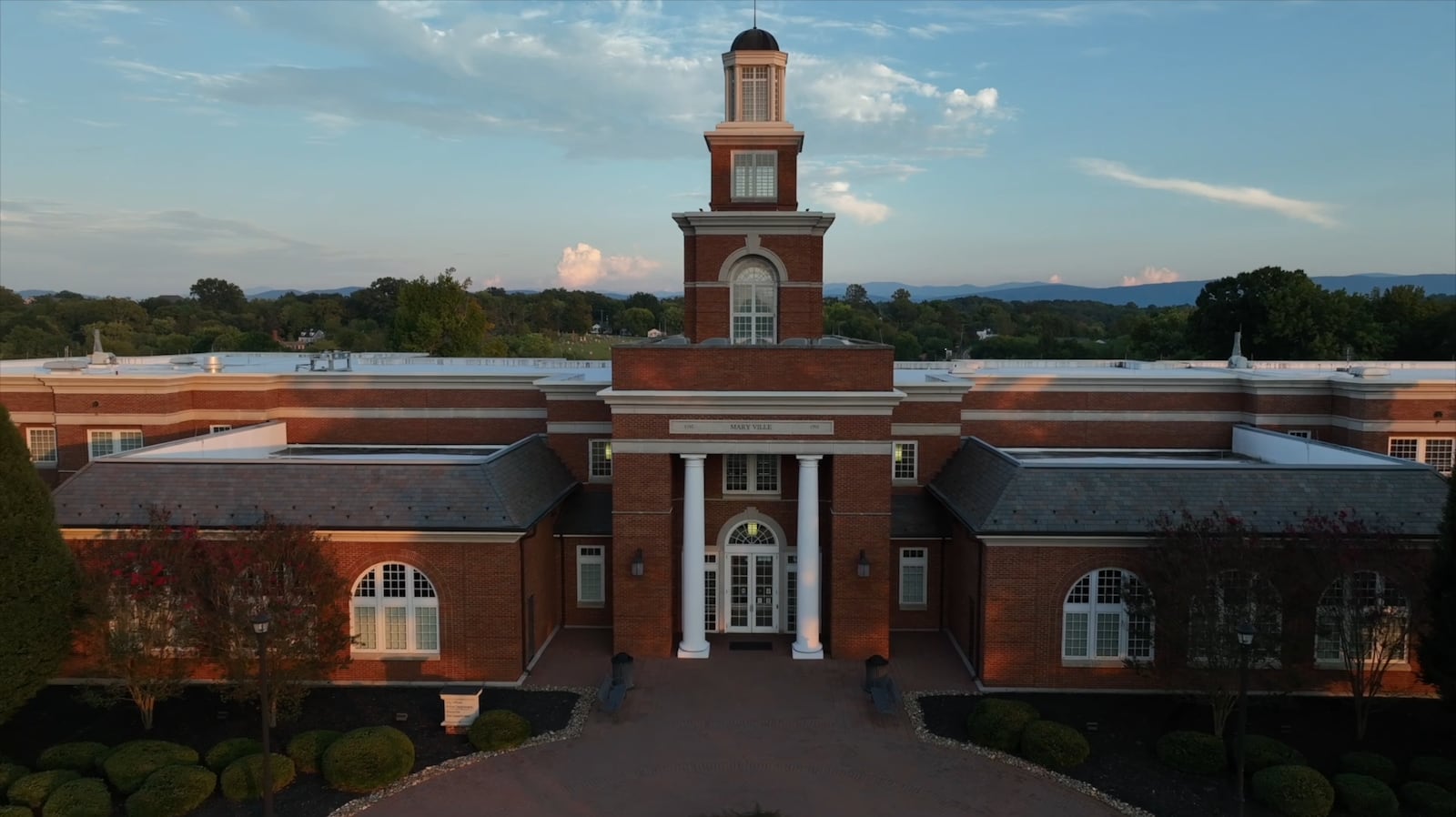
Maryville’s police chief told InvestigateTV the list exists for a narrow, technical reason — to correct for the system’s own errors, not to grant special treatment: “These entries were whitelisted after our Flock cameras repeatedly generated hotlist alerts because of apparent misreads of similar-looking characters in plate images.”
Flock, for its part, said what Maryville has is what the company calls a “suppressed hit,” separate from a feature called a “Safe List,” which a spokesperson said is now only available to private customers such as homeowners associations and businesses.
“In the past, Flock did offer Safe List functionality to some law enforcement customers that wanted the ability to exclude certain vehicles from their own system. The feature was not widely used by law enforcement agencies and was subsequently removed from the law enforcement product,” a company spokesperson said.
However, in the dozens of Flock sole-source letters for its ALPR system InvestigateTV reviewed, “Privacy controls to enable certain vehicles to ‘opt-out’ of being captured” was listed as a proprietary feature of “the only Law Enforcement Grade ALPR System.”
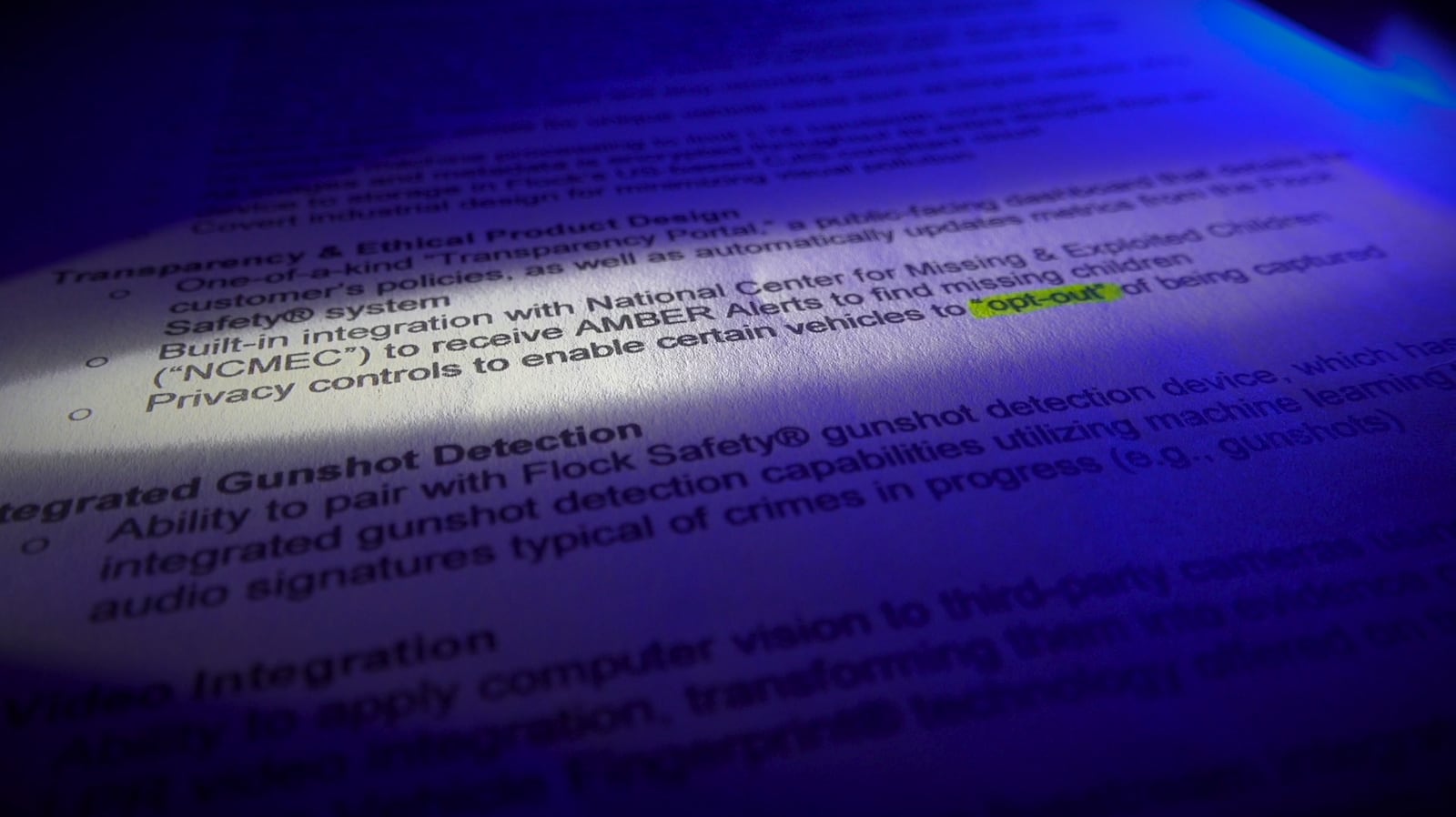
Asked directly about this, the spokesperson said: “A small number of outdated sole source letters were used in error and referenced an opt-out function that is no longer available to law enforcement customers.”
InvestigateTV found letters from 2020 to 2026, including multiple from March and April of this year, that contained the “opt-out” line, and a version of the letter containing the line was submitted as justification as recently as mid-August by the Jacksonville Sheriff’s Office — prior to the county canceling its contract in early September.
Skeen said the uncertainty cuts in a troubling direction, since the public has no way to check who benefits from the exemption.
“That’s the huge problem with this, is we don’t have transparency, and we don’t have regulations, and we’re not watching the system,” Skeen said. “We really are just left to guess on what this could be.”
“I don’t believe that these do coincide with the Constitution”
Skeen comes from what he calls a law enforcement family — not an activist background.
“In my family, you went to the military or you went to law enforcement, or a combination,” he said.
But he said the scale of what he uncovered doesn’t square with the oath he took.

“I don’t believe that these do coincide with the Constitution, and that is the biggest issue with these systems,” Skeen said. “Although they might be powerful, they might be preferred, but I do not believe that they hold in standing with the Constitution.”
He said he’s raised those concerns directly with Maryville’s city council, warning of “the dangers of putting in mass surveillance on Americans.”
Skeen said to him, the benefits are not worth the risk.
If there’s something you would like Atlanta News First Investigates to dig into, fill out this submission form.
Copyright 2026 WANF. All rights reserved.
News Source : https://www.walb.com/2026/10/12/flock-cameras-went-up-without-some-city-councils-approval-we-found-out-why-2/
Other Related News
10/13/2026
AUSTELL Ga AP - Police are investigating after a man fell to his death from a roller coast...
10/13/2026
COFFEE COUNTY Ga WALB A Coffee County firefighter is behind bars for alleged sexual batte...
10/13/2026
Gray News - A SpaceX rocket launch from Florida early Tuesday morning lit up the sky in se...
10/13/2026
ALBANY Ga WALB A shooting occurred at Blakey Place Apartments at around 540 pm according t...
10/13/2026
Gray News - Six Flags has temporarily closed nine roller coasters across six amusement par...

Follow

Download Our App


Copyright 2022 © Albany Metro Community. All Rights Reserved